All things Honors at Ball State
News & Notes
  • News
  • Notes
  • Faces
  • About
  • Archives
  • Print

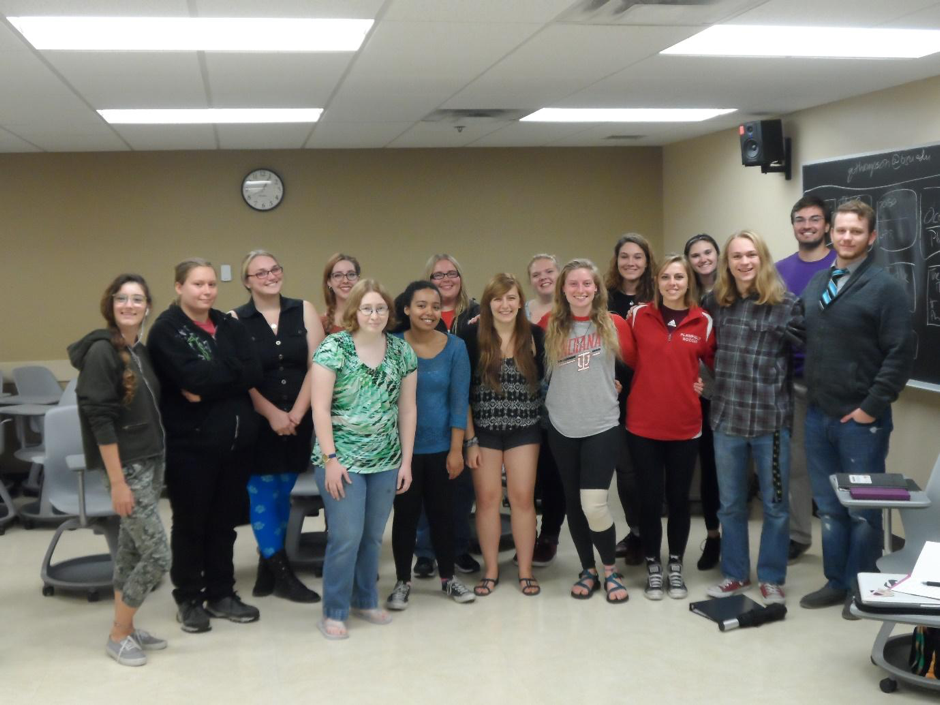
The Baddest Gang in DeHo

10/28/2016

0 Comments

 
By Alex Bravard
Oftentimes we don’t think of bathrooms as a bonding area. They’ve got a limited use; as implied by the name they are rooms in which to bathe. In the case of the Bathroom Girls (BRG), however, the humble bathroom has transcended its origins. These eight Honors freshmen have used their common bathroom as something to bond over. Two of these girls, Kimberly Parkhurst, a social studies education major, and Katie Esarey, a biology major, sat down to talk to me about this experience.

The group was thought up of at the beginning of year when these eight girls were filling out their bathroom agreement. It was around 10:30 or 11 o’clock at night.  “We all started talking and then it just all happened,” Kimberly said. (One has to wonder how that comes up in conversation, though.) Katie credits the actual idea of the BRG to chemistry major Sydney Bivens. The girls even gave themselves names by placing sticky notes above their towel hooks  and writing their names on the notes.

If you’re ever unfortunate enough to have to…”visit” these girls, more than likely you will start in room 102, or the Interrogation Room. This room is the home of Kimberly, aka the Stabber, and musical theater major Kelsey Krigas, aka the Muscle. Kimberly is named the Stabber for her affinity to wash her knives off in the bathroom sink. She was kind enough to warn the other seven girls though. Kelsey is nicknamed the Muscle because of the fact that she has the muscles.

If they don’t get the information they want, Kelsey will accompany you across the hall to room 103, or the Torture Chamber. This room is occupied by the two biology majors: Katie, aka the Enforcer, and Taylor Johnson, aka Doc. Katie’s nickname comes from her, she says that she just wanted to be known as the Enforcer. Taylor was named Doc due to her massive first aid kit. It’s not even a kit; it’s a tote.

If you’re incredibly unlucky, Taylor will take you to room 101, or the Infirmary. This room houses computer technology major Joanna Morton, aka Child Prodigy or Intel, and marketing major Nicki Croft, aka the Sniper. Joanna is named Intel because she works with computers and Nicki is nicknamed the Sniper because you’ll never see her.

​No matter what happens, you’ll never see the inside of Room 104, or Headquarters, as this is the nucleus of the cell. It holds Sydney, aka Gang Boss, and nursing major Mattison Hill, aka Smiley Face or the Good Cop. Both Sydney and Mattison chose their nicknames themselves; Mattison by writing a Smiley Face on her sticky note.

​
(Disclaimer: They don’t actually treat their guests like they’re on the wrong side of the mob. In fact, they’re extraordinarily nice.)
0 Comments

Opera Finds a Home in the Humanities Sequence

10/26/2016

0 Comments

 
By Mary Cox
A senior’s unique co-teaching experience has led to a brand new approach to Honors humanities.
The Honors humanities sequence is a diverse series of classes that highlights Western intellectual history through both ancient and contemporary literature, philosophy, and fine arts. For the past year and a half, however, Jason Powell, Assistant Professor of Honors Humanities, and Valerie Weingart, a senior vocal performance major, have been working to develop a course that uses the performing arts, specifically opera, as the content catalyst.

“In the humanities sequence we’re supposed to teach art, but most of us only do the plastic arts - painting, sculpture, architecture - we don’t focus on performance art. We do what we’re more comfortable with,” Powell said. “I thought if I’m always suggesting to my students to expand beyond their horizons and search out new opportunities to experience the arts, then why was I not doing the same? I need to stretch myself in the same way I ask my students to stretch themselves.”


Powell first became interested in opera while teaching a course on German philosopher Friedrich Nietzsche, who was friends with the famous German composer Richard Wagner.


“That’s where I really got the idea of maybe teaching something with opera. But I knew I didn’t know anything,” Powell said.


He began reading up on the art form, but ultimately decided to begin reaching out to music students for help. When he presented the opportunity to Weingart during last fall’s Curriculum Crash Course, she jumped at the opportunity. Weingart, who has been training as a classical singer since age 12 and studying music since age 5, was enthusiastic to share her love of opera with other students.


“I’ve always regarded [opera] as this very prestigious art form. And then when I started learning some of the historical aspects of it that was even more fascinating,” Weingart said.


The next semester, spring 2016, Weingart began leading small 25-30 minute lectures once a week for Powell’s 202 course.


“[Jason] basically said, ‘teach them, teach me, and let’s see what we can do with this.’ It was a big experiment,” Weingart said.


The pair were both nervous. This was Powell’s first experience co-teaching with a student and Weingart was worried the students would not receive her or the material well.  


“I was expecting them to find it kind of dull,” Weingart said, “and I was expecting them to be upset that I was taking away from the time they could have with Jason and learning from Jason.”


The reviews, however, have been overwhelmingly positive. Powell said that both in person and on course evaluations the students frequently mentioned how much they enjoyed having Weingart in class.


“You could get a sense that as a fellow student they’re rooting for her because they understand how hard this was going to be. It built up a sort of camaraderie between the class and Val in a fun way,” Powell said. “My students weren’t afraid to tell me afterwards that they’d rather have Val teaching some stuff.”


The feeling was mutual. Weingart said that her time with Powell’s class had reinforced that teaching at the collegiate level is what she wants to do once she graduates.


“It’s so refreshing, because being a musician for as long as I have been, stuff doesn’t take me by surprise anymore. It’s so interesting to watch [the students’] reactions, because a lot of them are so completely unfamiliar with this whole thing,” Weingart said.


Powell agrees that Weingart has found her calling, saying, “Val is very gifted and sharp, and she’s going to make an excellent teacher in her future.”


The only issue Powell and Weingart have experienced throughout this experiment was integrating opera smoothly into the rest of the literature heavy humanities sequence.


“I was just adding on to Jason’s class, but I wasn’t really meshing with it. I was this weird outlier,” Weingart said.


Powell and Weingart parlayed this road block into Weingart’s senior Honors thesis and the two are now working to develop an Honors 202 course that combines opera history with the other topics of the humanities sequence.


“Instead of having a baseline of all this literature and philosophy and throwing opera on top of that, what wanted to find out what would it be like to flip it.” Powell said. “We let opera sort of call the thematic shots.”


Weingart said that her ultimate goal for this course would be to remove the stigma of stuffiness and mystery from opera and make it more accessible to everyone.


“The main goal of what I’m designing is that the person teaching it does not have to be a musician or have musical background in order to teach it effectively, and the students don’t need to have a musical background in order to learn it effectively,” Weingart said. “I think by learning the history and what it [opera] was designed to do and the people it was designed to effect and the issues that are prevalent in some of the operas it becomes something they can embrace.”


Weingart’s syllabus is nearly complete, and she and Powell traveled to Seattle, WA earlier this month to present their work at the National Collegiate Honors Council (NCHC) Conference. Powell hopes to beginning implementing this syllabus for his courses starting in spring of 2018. He is also hoping that Weingart will be willing to come back to help him launch the course.


“It’s been wonderful to do something new that I felt good about doing because I had someone so confident working with me,” Powell said.


Until then, students can begin getting their feet wet with opera by attending the two productions The School of Music will be putting on later this year. The first will be Beatrice aet Benedict
on Thur, Dec 1 and Sat, Dec 3 in Pruis Hall. The second will be The Marriage of Figaro - Weingart’s favorite - in Sursa Hall on Fri, March 31 and Sun, April 2.


“It’s all students performing, so it’s another step to taking the fear and mystery out of going to an opera because it’s in a familiar space with familiar people,” Weingart said.

​
If December is still too far away, News and Notes can offer you this opera fun fact from Weingart: Legend has it that Mozart didn’t write the overture to his opera Don Giovanni until the morning of the premiere.
Picture
Picture
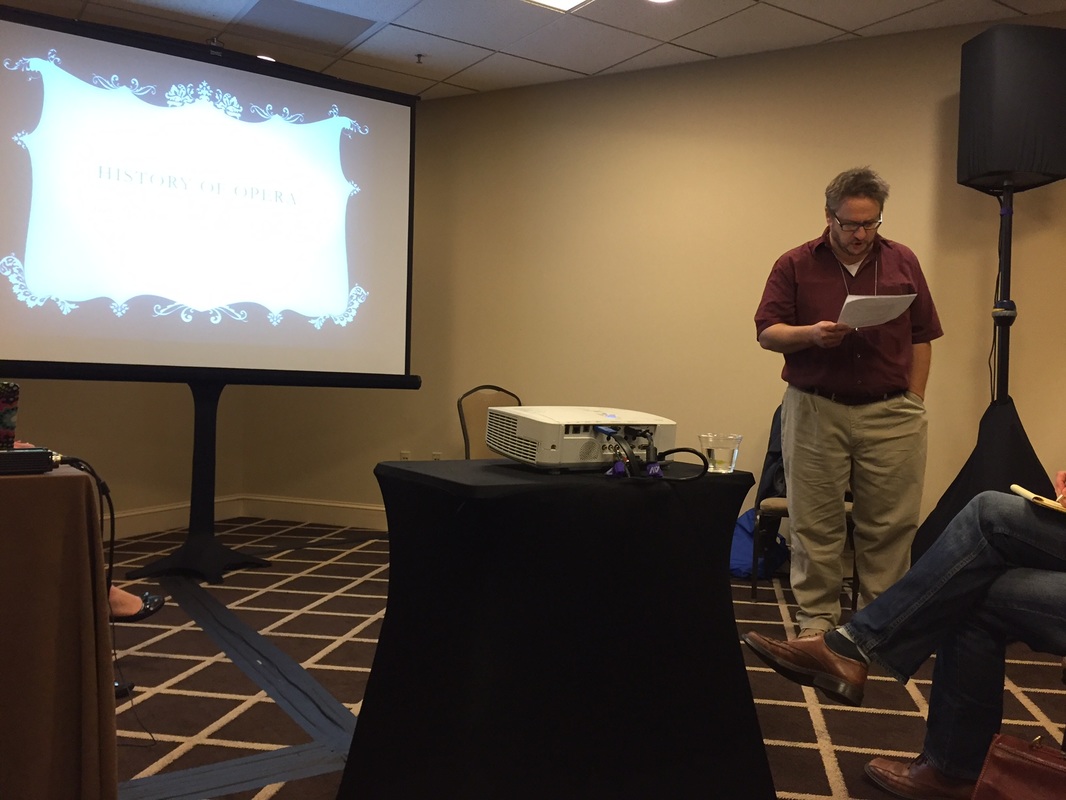
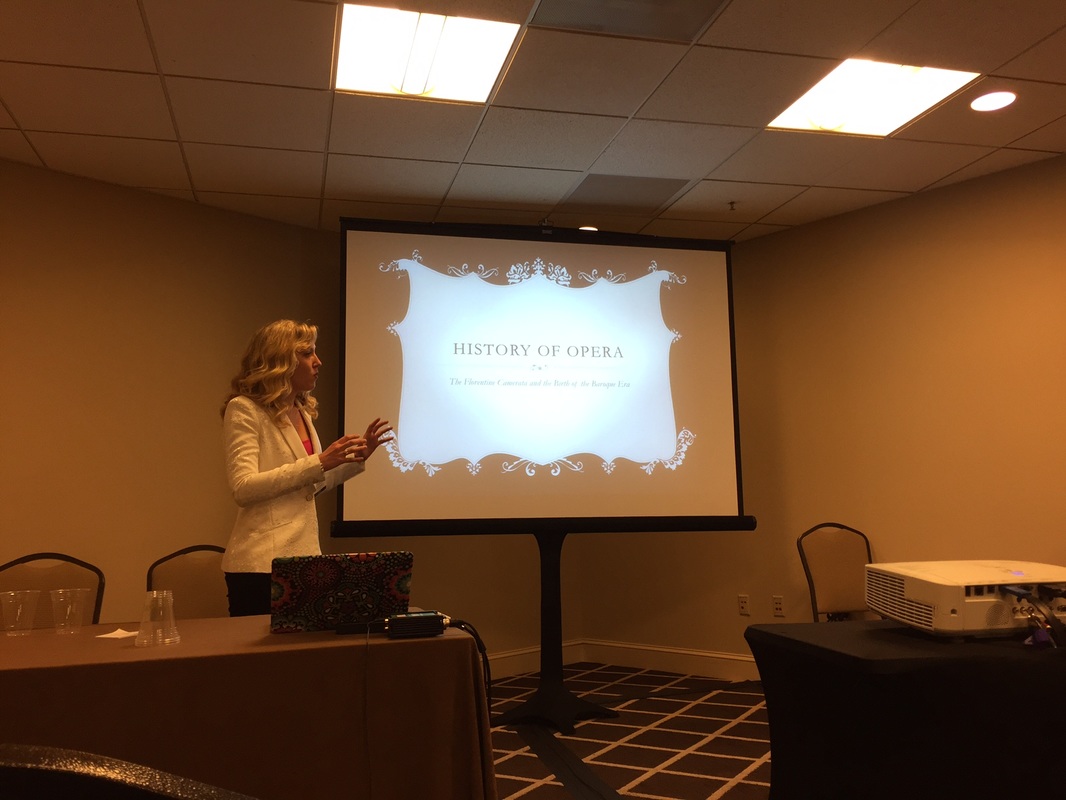
Valerie and Jason recently took their idea on the road, presenting about the work they have been doing to integrate opera into the humanities at this year's NCHC Conference. Jason explained what they had been trying to do with their work, and Valerie presented a version of a lesson she might teach in a humanities class.
0 Comments

REVIEW: Puck and Co. Perform in Pruis

10/19/2016

0 Comments

 
By Noah Patterson
Last night the Cincinnati Shakespeare Company performed their annual Ball State show in Pruis Hall.
Shakespeare always seems to have a certain appeal to Honors and English students. Last night, in the auditorium of Pruis Hall, there was no exception to that rule. The Cincinnati Shakespeare Company, an ensemble troupe that performs various Shakespeare plays, among other classics, came to Ball State University to put on A Midsummer Night’s Dream, an event sponsored by the Honors College, the College of Science and Humanities, the College of Fine Arts, and finally, the English Department.

The Cincinnati Shakespeare Company is famous at Ball State for their small casts and minimal set designs: in fact, there were only six performers for a play that consists of eighteen characters, and, instead of a set, several freestanding red curtains served as  the backdrop, draped in a sign stating Athens or covered in foliage based on the setting of the scene. And though their troupe be little, the performances are fierce.

Each actor, in order to compensate for the gap in performers to number of characters, took on multiple roles. This was nothing short of remarkable to watch. As each actor seamlessly blended from persona to persona, never mixing up their lines and enduring quick-changes onstage, it was hard to pick a standout performance. In fact, the chemistry this ensemble shares elevates each actor to the same high level of regard.

​
When analyzing a performance of Shakespeare, it is difficult to critique the plot - instead of attempting to discuss the positive and negative aspects of an iconic and beloved play, it is more productive to investigate what the performers do with the plot to make it unique or relevant to their audience. The Cincinnati Shakespeare Company did not disappoint in their rendition of A Midsummer Night’s Dream.

Practically the only aspect of A Midsummer Night’s Dream that remained true to  traditional performances was the dialogue, which was also updated time-to-time with modern references. Most of these opportunities were left for the character of Puck, the notorious fairy whose penchant for mischief and comedy seems particularly well-suited to this experimentation.

Another experiment primarily reserved for Puck and the fairies in this presentation of A Midsummer Night’s Dream was the incorporation of music, song, and dance. While many of the music cues illuminated what was going on in the play effectively (such as the fairies controlling the characters with their magic) and the dances were well choreographed, the songs seemed out of place at times. Although Shakespeare is easy to experiment with musically due to its rhythmic prose, the hip-hop inspired renditions of spells and magic felt clunky and at times cliche, an obvious reference to the Hamilton-craze. I typically would not fault a play for Hamilton influences, but these portions of the play were the least impressive for me personally.

Even though the songs did tend to fall flat, the technical aspects did not. Watching the play, it quickly became apparent that the actors were not only performing, but working as their own crew. This rendition of A Midsummer Night’s Dream is typically a part of Cincinnati’s Shakespeare in the Park series, meaning it is performed outdoors, in natural light, just like it would have been in Shakespeare’s day. Therefore, the actors do not have a crew to operate the lights, change the set, or initiate music cues. One actor, at all times, is behind the curtain, ensuring that nothing misses its mark.

The actors truly shined during the drama between Hermia, Demetrius, Lysander, and poor, misguided Helena. Again, the chemistry these actors have with each other is palpable. Their comfort onstage, interpretation of the lines, dedication to their “fight” scenes, and personal gesticulations while delivering their lines heighten the performances and make them a joy to watch. Particularly amazing was watching Aiden Sim’s sweethearted Hermia become enraged at Lysander’s sudden love for Helena - her anger, body language, and movement onstage are beautifully juxtaposed, making her betrayal, confusion, and outrage seem particularly jarring and effective.

The costuming, minimalistic in design, but very effective, was most prominently displayed in the simple but comical donkey mask for Nick Bottom. Accompanied by a hearty “hee-haw!,” Nick’s character became the perfect ass for Titania’s love. The costumes also became a crucial identifier for each character. While the actors only had mere seconds to change onstage, each costume was still distinct and complex enough to allow the audience to differentiate Lysander from Francis Flute.

Overall, the Cincinnati Shakespeare Company’s performance of A Midsummer Night’s Dream was as compelling to watch as it was fun. They were not afraid to take risks, and while some of them did not pay off as well as others, they were appreciated nonetheless. Having seen Midsummer performed at Shakespeare’s Globe in London just this last summer, I can confidently say that the high expectations set by that performance were met last night in Pruis. The remarkable differences between each performance kept the material fresh, enjoyable, and exciting, and sitting in a comfortable chair in Pruis instead of standing as a Groundling after a day of exploring London may have helped too.
Picture
4.5 Willy Shakes out of 5
Editor’s Note: Pictures of the performance were omitted to respect the actors onstage during the show.

Cast:
Kyle Brumley - Demetrius, Nick Bottom
Brandon Joseph Burton - Oberon, Theseus, Snug
William Cary Davenport - Puck, Egeus
Vanessa Sawson - Titania, Helena, Hippolyta, Tom Snout
​
Aiden Sims - Hermia, Peter Quince, Robin Starvelling, Fairy
Crystian Wiltshire - Lysander, Francis Flute, Fairy


Characters Omitted:
Philostrate, Additional fairies
0 Comments

Going Green: DeHority Residents Work for Campus Change

10/3/2016

0 Comments

 
By Caitlin Masterson
The Green Action Team (GAT) began meeting two weeks ago to brainstorm ways to improve sustainability efforts on Ball State University’s campus.  GAT is a part of the larger student organization Partnership for Sustainable Student Advancement (PSSA), a group founded this year after the Ball State Energy Action Team (BEAT) outgrew its name.  PSSA now includes both BEAT and the Recycling Action Team (RAT).  Both BEAT and RAT have names relevant to their specific responsibilities, but what does the Green Action Team do?

GAT is responsible for improving everything, besides energy conservation and recycling, that falls under the umbrella term “sustainability efforts.”  The group works to network with other student organizations and the residence and dining halls on campus in order to address student concerns about Ball State’s impact on the environment.  Students are represented by Eco-Reps from their residence halls.  Eco-Reps work with hall directors and Resident Assistants to implement policy changes and organize events within the halls to raise awareness of environmental issues.

DeHority Hall has three Eco-Reps, two of whom are sophomore actuarial science major Kelli Kramer and sophomore classical culture major Allie Hartman.  When asked what they would like to see improved in DeHority and on campus in general, Kramer replied, “We do not do enough.  We have a lot of recycle bins, but they’re not effective.”  Hartman commented, “Even if I only convince one kid in my hall to use silverware instead of plastic utensils…it’s [an] improvement.”

​
DeHority residents have been among those expressing their interest in improving sustainability efforts on campus. Hannah Banks, a sophomore Latin education major, suggested educating students about the blue recycling bags in dorm rooms.  Rebecca Weber, a sophomore speech pathology major, proposed placing more water bottle fountains on campus, both inside and outside of the buildings.


Quintin Thompson, a senior political science and philosophical studies double major and an executive director of PSSA, mentioned the ‘Tragedy of the Commons’ at the second GAT meeting, which underlines the idea that individuals will act in their own best interest without considering the ways their actions may work against the common good if the individual doesn’t have an understanding of why they  ought to consider the common good:  “Solutions can’t come from policy and technology.  Change must come from a change in the culture itself.”
Picture
The Green Action Team meets every Thursday at 7 p.m. in NQ 039 to discuss their plans to make Ball State University a more sustainable campus.
0 Comments

    News

    Events, trends, and happenings in the Honors community and beyond.

    Archives

    April 2018
    March 2018
    January 2018
    November 2017
    October 2017
    September 2017
    May 2017
    February 2017
    November 2016
    October 2016
    September 2016
    August 2016
    April 2016
    March 2016
    February 2016
    December 2015
    November 2015
    October 2015
    September 2015
    April 2015
    March 2015
    February 2015
    January 2015
    December 2014
    November 2014
    October 2014

    Categories

    All
    Air Jam
    Awards
    Courses
    Dean
    DeHority
    Events
    Freshmen Reader
    Graduation
    Halloween
    Homecoming
    Honors Weekend
    Lecture Series
    Myths
    Q&A
    SHC
    SHC Events
    Trends

    RSS Feed

Powered by Create your own unique website with customizable templates.